
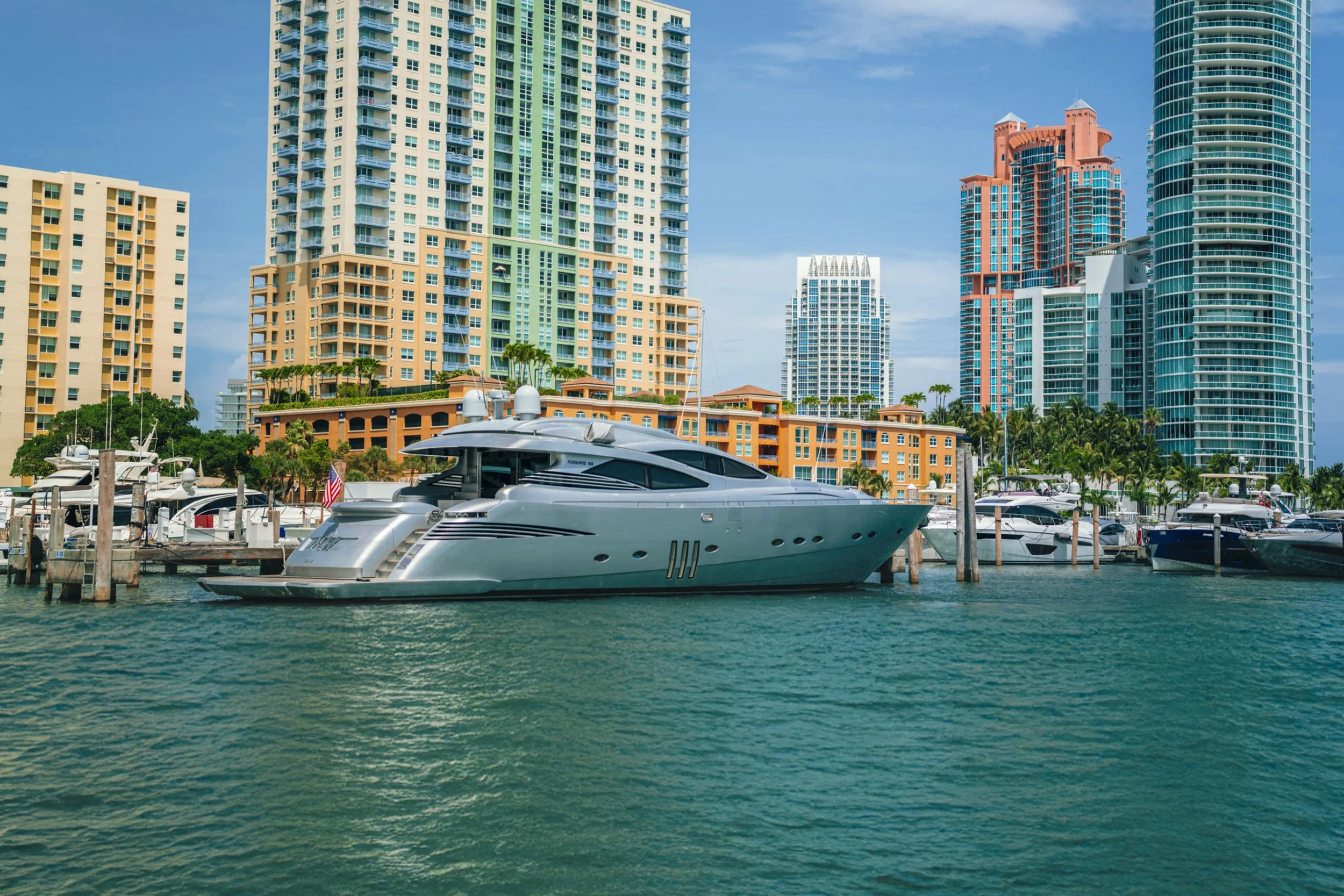
What does a yacht charter in Miami actually cost?
Base rates, fuel, crew gratuity, APA, and every add-on explained honestly, so nothing catches you off guard.
You've found a yacht you love. The website says "Starting from $2,000." You're thinking: okay, so roughly $2,000. It won't be $2,000. That's not a bait-and-switch, it's just how charter pricing works.
There are legitimate costs layered on top of a base rate, and most companies bury them in fine print or skip the explanation entirely. This guide does the opposite.
The short version: budget 30–50% above the base rate once you factor in crew gratuity, catering, and any add-ons. For most day charters, fuel is already included. Read on for the full breakdown.
How Long Is a Charter and Why It Affects the Price
The industry standard is a 4-hr minimum. This covers the crew's time, the cost of preparing and returning the vessel, and makes the economics work for the boat owner.
Rules can flex based on boat size. Smaller boats with lower operating costs and minimal crew can sometimes accommodate 2 hour charters and it's worth asking if you don't need a half or full day.
Larger yachts (50ft and above) start with at least two crew and typically have a captain and deckhand or stewardess. On larger yachts you may have six to eight crew on board. More crew means higher minimums. That 4-hour floor is firm on anything significant, and 8 hours for anything over 100ft.
Base Rate by Yacht Size
For a standard 4-hour charter in Miami before gratuity, tax and add-ons.
 Saxdor 32'
Everyday boats
Up to $3,000 · 1 crew
 Prestige 52'
Most popular
$3,000 – $5,000 · 2–3 crew
 Azimut 88'
Full luxury
$5,000 – $10,000 · 3–5 crew
 Azimut 118'
No compromises
$10,000 and above · 5–8 crew
Start a conversation
Tell us what you have in mind, we'll help you plan an experience worth remembering.
Fuel: The Cost That Confuses Everyone
Here's what most charter companies forget to say upfront: for 99.9% of day charters, fuel is included.
Normal cruising around Biscayne Bay, visiting sandbars, anchoring off the islands. These all run at slow-cruising speed, and that fuel cost is already factored into your base rate. You are not getting a fuel bill at the end of a standard day on the water.
If you've chartered a performance boat and want to run it flat out, fuel consumption spikes dramatically. In that case, actual fuel usage above the standard allowance may be charged separately.
If high-speed runs are part of your plan, just ask how fuel is handled before you book. Any reputable company will give you a straight answer.
For multi-day (term) charters, fuel is handled through an APA, explained below.
Crew Gratuity: Budget 15–20%
Tipping your crew is standard practice in the industry, it's a meaningful part of how crew members earn their income. The guideline is 15–20% of the base charter rate.
Most companies quote gratuity separately, which means it shows up as a surprise at the end of the day. We include 15% in our pricing upfront so you know exactly what you're paying.
You're always welcome to tip extra for a crew that goes above and beyond. On a $2,000 charter the base tip is $300. On a $5,000 charter it's $750. It's calculated on the charter rate, not the total bill.
Security Deposit: Less Scary Than It Sounds
Unlike renting a car or vacation home, a yacht charter doesn't require you to hand over a lump-sum deposit upfront.
A credit card is kept on file, and if there are any damages or incidentals, those are handled according to the charter agreement.
For the vast majority of guests on well-maintained yachts, the card on file is never touched.
What Is APA and Why Does It Matter?
If you're looking at a multi-day or overnight charter, you'll encounter the term APA: Advance Provisioning Allowance. It sounds complicated. It isn't. The base charter rate covers the boat and crew.
The actual running costs of a multi-day trip like fuel, provisions, docking fees, and port charges can't be priced exactly in advance because they depend on where you go and what you do.
So rather than guessing, the charter industry uses an APA.
How APA works: You pay 30% of the charter rate upfront. That money funds the trip's running expenses as you go, the captain draws from it for fuel, provisions, and docking. Every receipt is tracked. At the end, the accounts are settled: any money left over is refunded to you or applied toward crew gratuity. If expenses ran over, you pay the difference.
For shorter overnight or 24-hour charters where costs are more predictable, a pre-defined APA amount is sometimes agreed on upfront rather than the standard 30% formula. Same principle, just a fixed number both sides agree to in advance.
Add-Ons That Increase the Final Bill
For day charters, the extras that most meaningfully increase the total are:
- Catering and Chef Service Bring your own food and drinks, or have your charter provisioned with a chef, full bar setup, and customized menus. Get a separate provisioning quote so you can decide how much to invest here.
- Water Toys Jet skis, flyboards, inflatables like slides are almost always add-ons rather than included. If water activities are central to your day, ask specifically what's included before you book.
- Photography and Video Some companies offer on-water packages. Nice for special occasions, easy to skip if you're watching the budget.
On term charters, catering and provisioning are covered by the APA, so they don't represent a separate line item the way they do on a day charter.
Real-World Budget Examples
Here's what a well-budgeted charter actually looks like once everything is on the table:
Questions to Ask
- Is fuel included, or is there a surcharge for extended or high-speed use?
- How many crew will be on board, and is gratuity included or extra?
- What's included in the base rate vs. what's an add-on?
- Is there flexibility on minimum hours for smaller boats?
- How are damages handled: separate deposit, or card on file?
- If this is a term charter, what is the APA rate and how is it settled at the end?
Any reputable charter company answers all of these without hesitation. Vague language around fees is a signal to look elsewhere.
FAQ
How much does a 4-hour yacht charter in Miami cost?
Base rates range from up to $3,000 for compact yachts under 50ft, $3,000–$5,000 for mid-sized yachts (50–70ft), $5,000–$10,000 for large yachts (70–100ft), and $10,000 and above for super yachts over 100ft. Add 35–50% once you include crew gratuity, catering, and any extras.
Is fuel included in a Miami yacht charter?
Yes, standard cruising fuel is included in the base rate for the vast majority of day charters. The exception is speed boats running at full throttle, where actual fuel consumption above the standard allowance may be billed separately.
What is APA in a yacht charter?
APA stands for Advance Provisioning Allowance, a fund, typically 30% of the charter rate, paid upfront to cover running costs on multi-day charters: fuel, provisions, docking fees, and port charges. The captain draws from it throughout the trip and provides a full accounting at the end. Any leftover amount is refunded or applied to crew gratuity.
How much should I tip the yacht crew?
The industry standard is 15–20% of the base charter rate. On a $2,000 charter that's $300–$400. On a $5,000 charter, $750–$1,000. Many companies quote gratuity separately, we include 15% in our pricing so there are no surprises at the end of the day.
Is there a security deposit for a yacht charter?
Most day charters don't require a separate upfront deposit. A credit card is kept on file and only charged in the event of damages or incidentals, as specified in the charter agreement.
Can I book a yacht for less than 4 hours in Miami?
The industry standard is a 4-hour minimum. Smaller boats with lower operating costs sometimes accommodate 2–3 hour charters, worth asking. Larger yachts (50ft+) with multiple crew members typically hold firm to the 4-hour minimum.
Start a conversation
Tell us what you have in mind, we'll help you plan an experience worth remembering.