
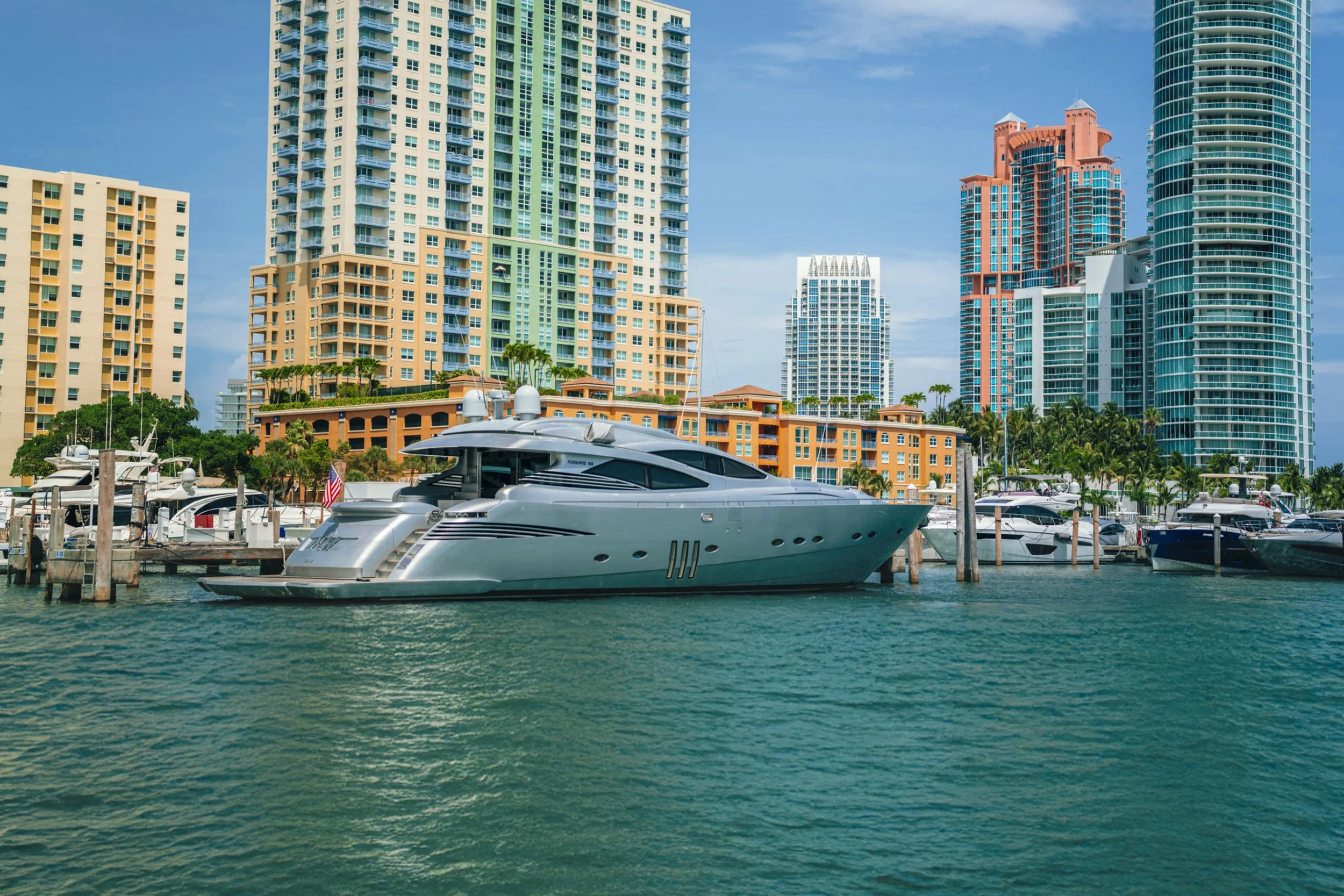
Should you buy a yacht and rent it out in Miami?
Yes, you can buy a yacht in Miami and put it into charter. Some yachts even operate profitably. But for most owners, profit should not be the reason for buying the boat.
Charter can offset ownership costs. In the right circumstances, it can do considerably more. But if the spreadsheet is the only reason you want the yacht, this is probably the wrong asset.
When can a yacht actually be profitable?
Profitability happens. It just does not happen by accident, and it rarely happens with an ordinary yacht bought at retail. Two patterns account for most of the cases that work.
Acquired at $120K with roughly $80K invested, operated for several years, sold at $289K. The point is not the number, it is the pattern. Buying exceptionally well, improving, operating and exiting well, not renting an ordinary yacht at retail.
A 100 foot class yacht heavily equipped with toys, run as a genuine fun factory. It outperforms because customers specifically want that product and it stands apart from every other yacht competing for the same booking.
For most owners, the better goal is cost offset
Own the yacht you actually want, then structure ownership intelligently enough that the asset works when you are not using it and you are not paying full carrying cost out of pocket.
Profitability generally requires an edge. Exceptional acquisition basis. Exceptional product. Exceptional utilization. Exceptional operating economics. Sometimes several at once. Otherwise you are buying the yacht you want and using charter to offset the cost of ownership.
The honest math on Miami
The good marinas either cap charter access or refuse it outright. In the years after COVID, several changed city codes, added curfews and stopped honoring charter contracts for non-resident vessels. What is left is a downtown, Miami Beach and Coconut Grove where slip availability for a chartering hull runs tight.
The public-facing charter market compounds that. A high share of what runs on the water on a busy weekend reads to us as non-compliant. No license, no bonding, no escrow, no marina fee absorbed. Guests see a compliant day rate and ask why it costs twice the boat next door.
Two archetypes, one right fit
Almost every good outcome we have written falls into one of two buyer profiles. The distinction is the single most important call a prospective owner will make.
Buying regardless, wants a structure that keeps the asset working when the family is not aboard. Section 179, a program capturing idle weekends, professional management, a broker ready to list. Ownership with a hedge, not a business.
The math almost never closes on an ordinary yacht. The exception is a fully loaded flagship in a near-uncontested category, the exception, not the model. Apply flagship returns to an ordinary boat and the numbers do not close.
What makes a yacht actually work in charter
Once an owner is committed to programming the boat, the specific hull decides how much of the carrying cost the calendar can offset. The vessels that book best in Miami share a handful of traits, and we walk this list every time before we quote a program.
- Layout and space Groups book the vessel that looks and feels like the day they want. A well-laid-out 60 footer will often outbook a poorly-laid-out 80 footer.
- Toys on board Jet skis, seabobs, paddleboards, floating mats. Every toy is a line item in the guest's decision.
- Shade and amenities Two things that quietly decide whether a group of ten spends four hours comfortable or four hours regretting the booking.
- Photograph-ability The listing sells the day. Interior finishes, exterior condition and the shots we can pull off the boat all move calendar conversion.
- Slip location Downtown, Miami Beach and Coconut Grove all book differently. The slip decides which guest walks aboard.
Start the ownership conversation
Full-lifecycle ownership. Purchase, management, charter program, resale. One relationship, one record.
FAQ
Can I buy a yacht and rent it out in Miami?
Yes. Florida allows it, and Miami has real charter demand for the right vessel. The complications are marina access, seasonality and a crowded low-price public market. A licensed bonded operator can run the program legally and cleanly, and the vessel itself has to fit what the market is actually chartering.
Can a yacht charter business actually be profitable?
For a small number of vessels, yes. Those tend to be fully-loaded flagship platforms in a category with almost no direct competition, run by an operator who can keep the calendar full. For most private-owner boats in the $500K to $2M window, charter offsets carrying cost rather than clearing pure profit, and modeling it as a standalone business usually disappoints.
How much of my yacht's expenses can charter revenue offset?
Well-programmed private-owner boats commonly offset a meaningful share of dockage, insurance, crew and maintenance. The exact figure depends on the hull, layout, seasonality and how many idle weekends we can convert. We will not quote a percentage until we have seen the specific vessel and slip.
What makes one yacht perform better in charter than another?
Layout, toys, shade coverage, aft-deck space, bathroom count and photograph-ability. Groups book the vessel that looks and feels like the day they want. Length matters, but a well-laid-out 60 footer will often outbook a poorly-laid-out 80 footer, and every toy on board is a line item in the guest's decision.
How much does it cost to own and operate a yacht in Miami?
Ballpark for a private-owner yacht in the 50 to 80 foot range, expect dockage, insurance, captain and crew, fuel, maintenance and unexpected items to run into six figures a year, with the exact number driven mostly by size, slip choice and how often she moves. We will build a real number against your specific vessel before you close.
Should I buy a yacht purely as an investment?
No, in almost every case. Yachts are depreciating assets that live in salt water and require continuous capital input. If pure return is the goal, put the capital into an appreciating asset class. If the yacht itself is the goal and the program is the hedge, that is a different conversation and one worth having.
What happens when the boat isn't chartering?
She sits at her slip accruing dockage, insurance and crew cost, and losing calendar utilization we could otherwise have booked. That is what a good program is designed to reduce. Idle weekends are where private-owner ownership economics either work or break, and where a serious operator earns their fee.
Can I still use my yacht if it's in a charter program?
Yes. Owner blocks come first on every calendar we run. The program books around what you and your family have committed to. The pattern that works best is owners flagging their known dates early each season so the charter side can fill the rest.
Does putting a yacht into charter affect resale value?
It can, in either direction. A vessel that has been chartered hard and maintained casually will show it on survey, and buyers will discount her accordingly. A vessel that has been chartered under a professional program with clean logs, real maintenance records and consistent captains often sells easier because her operational history is documented. Voyager runs the program with the eventual sale in mind.
Can yacht ownership qualify for Section 179?
For genuine business use, yes. Section 179 has historically allowed accelerated depreciation on qualifying assets placed in service for business use, and a chartered yacht run through a legitimate program can qualify. That is a conversation for your CPA against your specific tax situation, and it is one of the reasons the offset structure works as well as it does for high-net-worth owners.
Talk to Voyager
Full-lifecycle ownership. Purchase, management, charter program, resale. One relationship, one record.